 English
 繁體中文
繁體中文
 Deutsch
 Français
 Español
 日本語
日本語
 Tiếng Việt
 Português
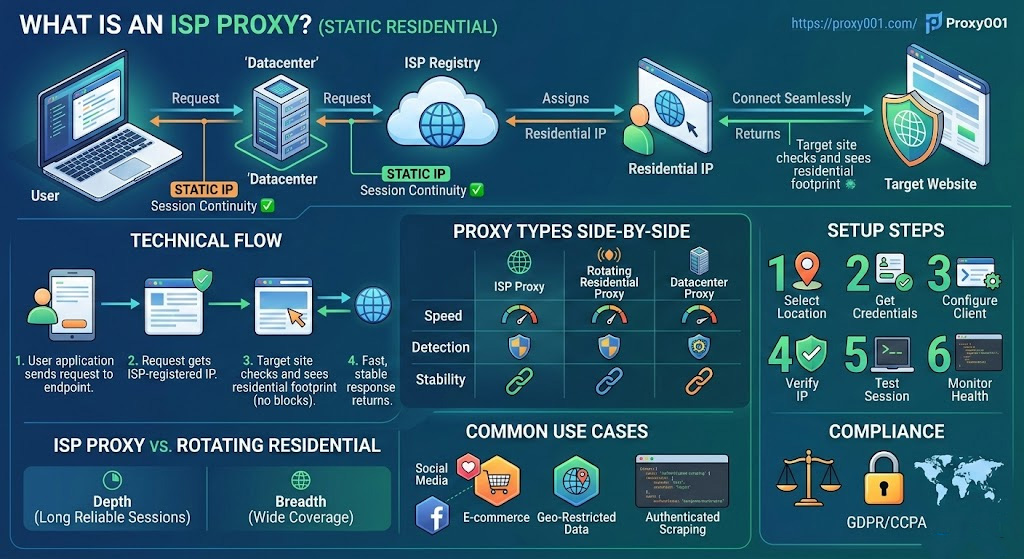
What Is an ISP Proxy?
An ISP proxy—also called a static residential proxy—is an IP address that is registered with a consumer Internet Service Provider (ISP) but hosted on a datacenter server. That combination gives it the best trait of each type: it looks like a real household connection to external websites, yet it runs on server-grade hardware with the speed and stability of a datacenter.
The term "static" is the key word here. Unlike rotating residential proxies that cycle through different home IPs, an ISP proxy keeps the same address for as long as you need it. You get a persistent, ISP-registered IP that doesn't change between requests—which matters a great deal for tasks that require login continuity or long-running sessions.
How ISP Proxies Work: The Technical Flow
The routing logic is straightforward:
You send a request — Your application routes traffic through the ISP proxy endpoint.
The request exits through an ISP-registered IP — Unlike a datacenter proxy, this IP is registered under a residential ISP (Comcast, AT&T, BT, etc.), not a cloud provider's ASN.
The target site checks the IP — It sees an ISP footprint, not an AWS or Azure range. The request passes bot-detection checks that would block a standard datacenter IP.
The response returns to you — Fast, stable, and consistent—because the underlying hardware is server-grade, not a home router.
The critical difference from a rotating residential proxy: the IP never changes mid-session. The same address handles every request until you release it.
The Three Proxy Types Side by Side
| Feature | ISP Proxy (Static Residential) | Rotating Residential Proxy | Datacenter Proxy |
| IP Source | ISP-registered, datacenter-hosted | Real home device | Cloud server farm |
| IP Stability | Static (persistent) | Rotates per request or interval | Static or rotating |
| Detection Risk | Low | Low | High |
| Speed | Fast (server hardware) | Moderate (home device) | Very fast |
| Session Continuity | ✅ Excellent | ⚠️ Limited | ✅ Good |
| Cost | Medium–High | Medium | Low |
| Best For | Long sessions, account management | Large-scale scraping | Speed-critical, low-risk targets |
ISP Proxy vs. Residential Proxy: Which One Do You Actually Need?
This is the question most people get wrong. They sound similar, but they solve different problems.
Choose an ISP proxy when:
Your task requires a persistent session—staying logged in, managing an account, or completing multi-step workflows without triggering re-authentication.
You need consistent geo-location—the same city-level IP across an entire project run.
Speed matters and you can't afford the latency variability of routing through actual home devices.
A single trusted IP identity over time is more valuable than IP diversity.
Choose a rotating residential proxy when:
You're doing large-scale data collection across many pages or products, where IP diversity matters more than persistence.
Your target site has aggressive per-IP rate limiting and you need to distribute requests across a wide pool.
You need broad geo coverage—hundreds of cities or regions—rather than one fixed location.
A practical way to think about it: ISP proxies are for depth (long, reliable sessions in one place), while rotating residential proxies are for breadth (wide coverage across many requests).
When Datacenter Proxies Fall Short—and ISP Proxies Fill the Gap
Datacenter proxies are fast and cheap, but they fail in one specific scenario: any target that checks whether your IP belongs to a residential ISP. Modern bot-detection platforms—Cloudflare, Akamai Bot Manager, PerimeterX—maintain ASN (Autonomous System Number) databases. A request from an AWS or Google Cloud IP range is immediately identifiable as non-residential, regardless of how you configure your headers.
ISP proxies sidestep this entirely. Because the IP is registered under a consumer ISP's ASN, it passes the same fingerprint check as a genuine home user. You get datacenter-grade speed with residential-grade trust signals—which is exactly why ISP proxies have become the preferred choice for account-based workflows where datacenter IPs consistently get challenged or blocked.
Common Use Cases for ISP Proxies
Social media and platform account management — Platforms like LinkedIn, Twitter/X, and Instagram tie trust signals to IP history. A stable, ISP-registered IP that maintains a consistent identity over weeks builds the kind of trust profile that reduces friction and account flags.
E-commerce and sneaker purchasing — Limited-release purchases require maintaining a session through product page → cart → checkout without an IP change triggering a session reset or bot flag.
Ad verification with session continuity — Verifying that a specific ad campaign displays correctly across a multi-page user journey requires the same IP throughout the session.
Accessing geo-restricted business data — Some enterprise platforms and regional databases serve different content based on IP location. An ISP proxy with a fixed city-level location provides reliable, consistent access.
Long-running web scraping on authenticated sites — When your scraping target requires login and maintains session state server-side, rotating IPs will repeatedly trigger re-authentication. A sticky ISP proxy eliminates this.
How to Set Up an ISP Proxy
Prerequisites:
An active account with a proxy provider that offers ISP/static residential proxies.
Your credentials: proxy hostname, port, username, password.
A client that supports HTTP/HTTPS or SOCKS5 configuration.
Steps:
Select your target location — Choose the country and city for your ISP IP. Unlike rotating proxies, you'll hold this location, so pick carefully.
Get your static proxy credentials — Your provider's dashboard will assign you a specific IP address, port, and authentication details.
Configure your client — In Python's
requestslibrary:
proxies = {
    "http": "http://username:password@isp-proxy-host:port",
    "https": "http://username:password@isp-proxy-host:port"
}
response = requests.get("https://target-site.com", proxies=proxies)
Verify your assigned IP — Send a test request to ipinfo.io through the proxy. Confirm the org field shows a consumer ISP, not a cloud provider, and that the location matches your target.
Test session persistence — Make two consecutive requests and confirm both return the same exit IP. If the IP changes, you may have accidentally configured a rotating endpoint instead of a static one.
Monitor for IP health — If your assigned IP gets flagged by a specific target, request a replacement from your provider. Check your provider's IP replacement policy before committing to a plan.
Compliance and Responsible Use
ISP proxies are legitimate infrastructure tools used across digital marketing, market research, brand protection, and security testing. The same legal framework applies as with any proxy type:
Only access data you're authorized to collect. Public-facing content is generally fair game; authenticated systems and private data are not.
Review the Terms of Service of every platform you access programmatically. ToS violations carry legal risk regardless of proxy type.
For EU and California operations, ensure your data collection practices comply with GDPR and CCPA respectively.
Stick to lawful use cases: ad verification, price monitoring, SEO research, account management for legitimate business operations, and security testing under authorized scope.
Start Using ISP Proxies with Proxy001
If your workflow demands the reliability of a static IP with the trust signals of a residential connection,
Whether you're managing accounts at scale, running authenticated scraping pipelines, or verifying geo-specific ad placements, a dedicated ISP proxy removes the friction that rotating IPs introduce. Visit