If you're evaluating proxy options for your next project, you've probably noticed that ISP proxies and residential proxies get recommended for seemingly similar tasks. Both mask your real IP address. Both can bypass geo-restrictions. Both appear as legitimate residential connections to target websites.
So when does it actually matter which one you choose?
The short answer: ISP proxies outperform residential proxies whenever speed, session persistence, and connection stability matter more than maximum anonymity or IP diversity. That's not a small category—it includes some of the most common commercial proxy use cases.
This guide breaks down the specific scenarios where ISP proxies deliver measurably better results, so you can stop overpaying for residential bandwidth on tasks that don't require it.
Quick Background: How ISP and Residential Proxies Differ
Understanding the architectural difference helps explain why each type excels in different scenarios.
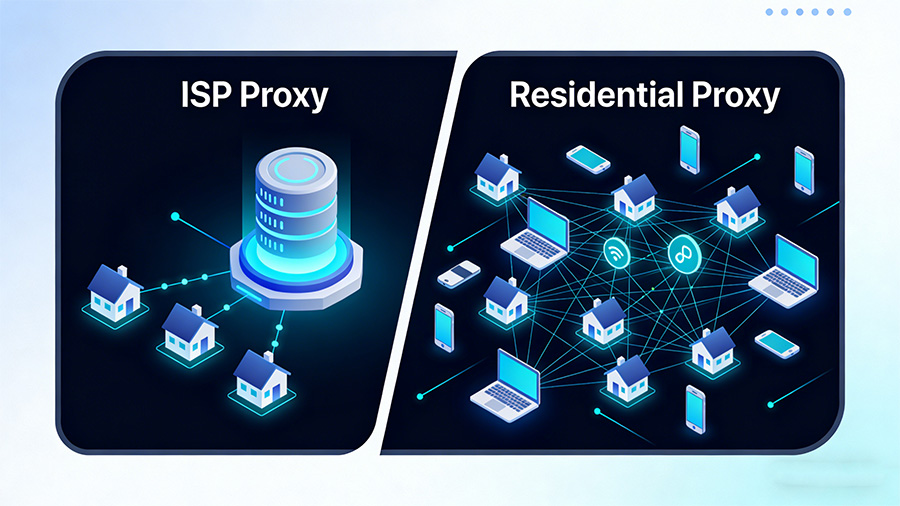
ISP proxies (also called static residential proxies) use IP addresses purchased directly from Internet Service Providers—companies like Verizon, Comcast, or AT&T. These IPs are registered under legitimate residential ASNs, meaning they appear as real home internet connections in IP databases. However, the actual traffic routes through high-performance datacenter servers. You get residential legitimacy with datacenter speed.
Residential proxies route your traffic through actual consumer devices—real phones, laptops, and home routers belonging to everyday internet users. Providers build these networks through SDK integrations in apps that compensate users for sharing idle bandwidth. The traffic path involves multiple hops through this peer-to-peer network before reaching your target.
The performance implications are significant. ISP proxies typically deliver 60-500ms response times and 50-100+ Mbps speeds. Residential proxies average 800-2,300ms latency with 10-50 Mbps throughput. ISP proxies maintain 99.9% uptime on dedicated infrastructure, while residential availability depends on whether peer devices stay online.
These aren't marginal differences. For certain use cases, they're decisive.
Sneaker Botting and Limited-Release Drops
This is the clearest example of ISP proxy superiority.
When Nike SNKRS drops a limited Jordan or Shopify stores release hyped collaborations, the checkout window often lasts seconds. Residential proxies averaging 1.5+ second response times simply cannot compete with ISP proxies delivering sub-300ms latency. In a first-come-first-serve race, speed wins.
But speed alone doesn't explain why ISP proxies dominate this space. Sneaker sites also deploy anti-bot measures that instantly block obvious datacenter IPs. ISP proxies solve both problems: they route through fast datacenter infrastructure while appearing as legitimate residential connections in WHOIS lookups.
The session persistence factor seals the deal. Queue-based systems like Footsites and Supreme require your IP to maintain consistent identity throughout the checkout flow. When you're waiting in a virtual queue, a rotating residential proxy that changes IPs mid-session loses your queue position. Static residential proxies hold the same IP indefinitely—your session stays intact from queue entry through checkout confirmation.
Verdict: For any limited-release copping requiring speed plus session stability, ISP proxies are the industry standard choice. Residential proxies for sneakers still have niche applications in initial account creation, but the actual copping runs on static IPs.
Social Media Account Management
Platforms like Instagram, TikTok, and Facebook track IP consistency as an authenticity signal. Accounts that frequently change IP addresses—especially across different cities or countries—trigger security reviews, action blocks, and verification requests.
This creates a fundamental problem for rotating residential proxies. Their strength (constant IP rotation for anonymity) becomes a weakness for ongoing account management. An account that appears to "travel" from New York to Chicago to Miami within hours looks suspicious because real users don't behave that way.
ISP proxies provide the stable, static IP addresses that social media management requires. The recommended setup is one ISP proxy per 5-8 accounts, with sessions running continuously for 24+ hours. This consistency builds the trust score that keeps accounts in good standing.
Specific social media proxies use cases favoring ISP infrastructure:
Account warming — New accounts need consistent activity patterns from stable IPs to establish legitimacy. Rotating IPs during the warming period signals bot behavior.
Engagement automation — Liking, following, and commenting actions spread across sessions require IP persistence to avoid triggering rate limits tied to "new" connections.
Content scheduling — Posting tools that maintain persistent API sessions work better with stable IPs that don't trigger "suspicious login from new location" alerts.
Verdict: For ongoing social media account management, ISP proxies' stability delivers better long-term account health than rotating residential alternatives.
SEO Monitoring and SERP Tracking
High-volume keyword tracking reveals clear performance differences between proxy types.
Benchmark testing shows ISP proxies achieving 100% success rates with ~2 second response times for Google SERP queries, compared to residential proxies' 88% success rate with ~4.5 second response times on identical targets. When you're tracking 10,000+ keywords daily, that speed difference compounds into hours of processing time saved.
The reason ISP proxies work well here: search engines apply moderate anti-bot measures to organic search queries. Google expects SEO tools to make automated requests and accommodates reasonable volumes. The sophisticated behavioral analysis that residential proxies help bypass—mouse movement tracking, rendering fingerprinting—simply isn't deployed at the same level for standard search queries.
Where residential proxies still matter for SEO is hyper-local SERP tracking. If you need results exactly as they appear in specific ZIP codes or neighborhoods, residential proxies' granular geographic targeting (down to city and postal code level) outperforms ISP proxies' broader country/region coverage.
Verdict: For standard keyword ranking monitoring at scale, ISP proxies deliver better speed and cost efficiency. Reserve residential bandwidth for local SEO requiring precise geographic targeting.
E-Commerce Price Monitoring
Competitive price intelligence operations often involve monitoring tens of thousands of SKUs across dozens of competitor sites with hourly refresh cycles. The math strongly favors ISP proxies.
Consider tracking 50,000 products across 20 retailers with hourly updates—that's 1.2 million daily requests. At residential proxy speeds (averaging 1.5 seconds), each monitoring cycle takes approximately 21 hours, leaving minimal buffer before the next cycle. At ISP speeds (averaging 0.4 seconds), the same cycle completes in under 6 hours.
Cost structures amplify this advantage. Residential proxies charge per gigabyte, typically $3-8/GB for standard providers. ISP proxies usually offer unlimited bandwidth at flat monthly rates ($1.30-8 per IP). E-commerce monitoring—which downloads full product pages, images, and JavaScript—burns through bandwidth rapidly. For sustained high-volume operations, ISP proxies can deliver 60-80% cost savings.
Most e-commerce sites deploy moderate protection that ISP proxies handle effectively. Amazon and other heavily-protected platforms remain exceptions where residential authenticity matters, but the majority of retail monitoring works reliably with static residential proxy infrastructure.
Verdict: For high-volume price monitoring across standard retail sites, ISP proxies provide better throughput and predictable costs.
Ad Verification (Regional Targeting)
Ad verification workflows split cleanly based on geographic precision requirements.
For standard regional verification—confirming campaigns display correctly across countries or major metropolitan areas—ISP proxies provide the speed needed to verify thousands of placements efficiently. Ad verification requires loading complete pages including creatives, tracking pixels, and dynamic ad elements. ISP proxies' superior bandwidth handles these payload-heavy requests without the timeout issues that affect residential connections.
The economics matter for agencies verifying campaigns at scale. Monitoring hundreds of publishers during campaign launches creates traffic spikes that ISP proxies' flat-rate pricing handles predictably, versus residential per-GB charges that can produce surprise overages.
However, hyper-local ad verification—confirming geo-targeted ads appear correctly in specific ZIP codes or neighborhoods—requires residential proxies. ISP proxy pools don't offer the granular location coverage needed to verify micro-targeted placements.
Verdict: Regional ad verification works better with ISP proxies. Hyper-local verification requires residential infrastructure.
API Access and Structured Data Collection
Legitimate data operations often involve API endpoints or structured feeds rather than scraping rendered web pages. These use cases almost universally favor ISP proxies.
APIs authenticate based on IP reputation and request patterns, not behavioral fingerprinting. They don't analyze mouse movements or browser rendering because they're designed for programmatic access. This eliminates residential proxies' primary advantage.
What APIs care about is rate limiting and session management. ISP proxies provide stable IPs that maintain authenticated sessions across sequential requests while delivering the speed needed to maximize throughput within rate limits. Residential proxies' latency variability creates unnecessary timeouts and session management complexity for API-based workflows.
Verdict: For API access and programmatic data collection, ISP proxies' speed and stability make them the clear choice.
When Residential Proxies Still Win
ISP proxies aren't universally superior. Residential proxies remain the better choice for:
Heavily-protected targets — Sites using DataDome, PerimeterX, or advanced Cloudflare configurations deploy behavioral analysis that can identify static residential proxy patterns. These targets require genuine residential traffic diversity.
Bulk account creation — Creating many accounts from the same subnet triggers spam detection. Residential pools with 50-100+ million IPs provide the diversity needed to avoid clustering flags.
Maximum anonymity requirements — Operations requiring the highest stealth levels benefit from residential proxies' genuine consumer traffic patterns.
Hyper-local geographic precision — When you need IPs from specific cities, ZIP codes, or neighborhoods, residential networks' granular coverage outperforms ISP options.
The smartest proxy strategies deploy both types: routing routine high-volume traffic through fast, cost-efficient ISP proxies while escalating to residential infrastructure when encountering blocks or accessing high-security targets.
Making the Right Choice
The decision comes down to matching proxy characteristics to your specific requirements.
Choose ISP proxies when:
Speed directly impacts success (drops, time-sensitive operations)
Sessions need to persist for hours or days
Targets use moderate anti-bot protection
Cost predictability matters for high-volume operations
Choose residential proxies when:
Targets deploy sophisticated behavioral detection
You need hyper-local geographic targeting
Maximum IP diversity is essential
Operations require mimicking genuine user patterns
For the use cases covered in this guide—sneaker copping, social media management, SEO monitoring, price intelligence, regional ad verification, and API access—ISP proxies deliver measurably better results through speed, stability, and cost efficiency.
Why Proxy001 for Your Residential Proxy Needs
While ISP proxies excel for the speed-critical use cases above, many operations require the flexibility to deploy residential infrastructure when facing sophisticated anti-bot systems or needing precise geographic targeting. Proxy001 provides premium residential proxies with 99.9% uptime, ethically-sourced IPs from 190+ countries, and flexible session options including sticky sessions up to 24 hours.
Our infrastructure handles the high-security targets where residential authenticity matters most—protected e-commerce platforms, social media account creation, and hyper-local data collection. Transparent per-GB pricing with volume discounts, plus 24/7 technical support from proxy specialists who understand your use cases.
Start your free trial at proxy001.com — experience the reliability that enterprise data operations demand.