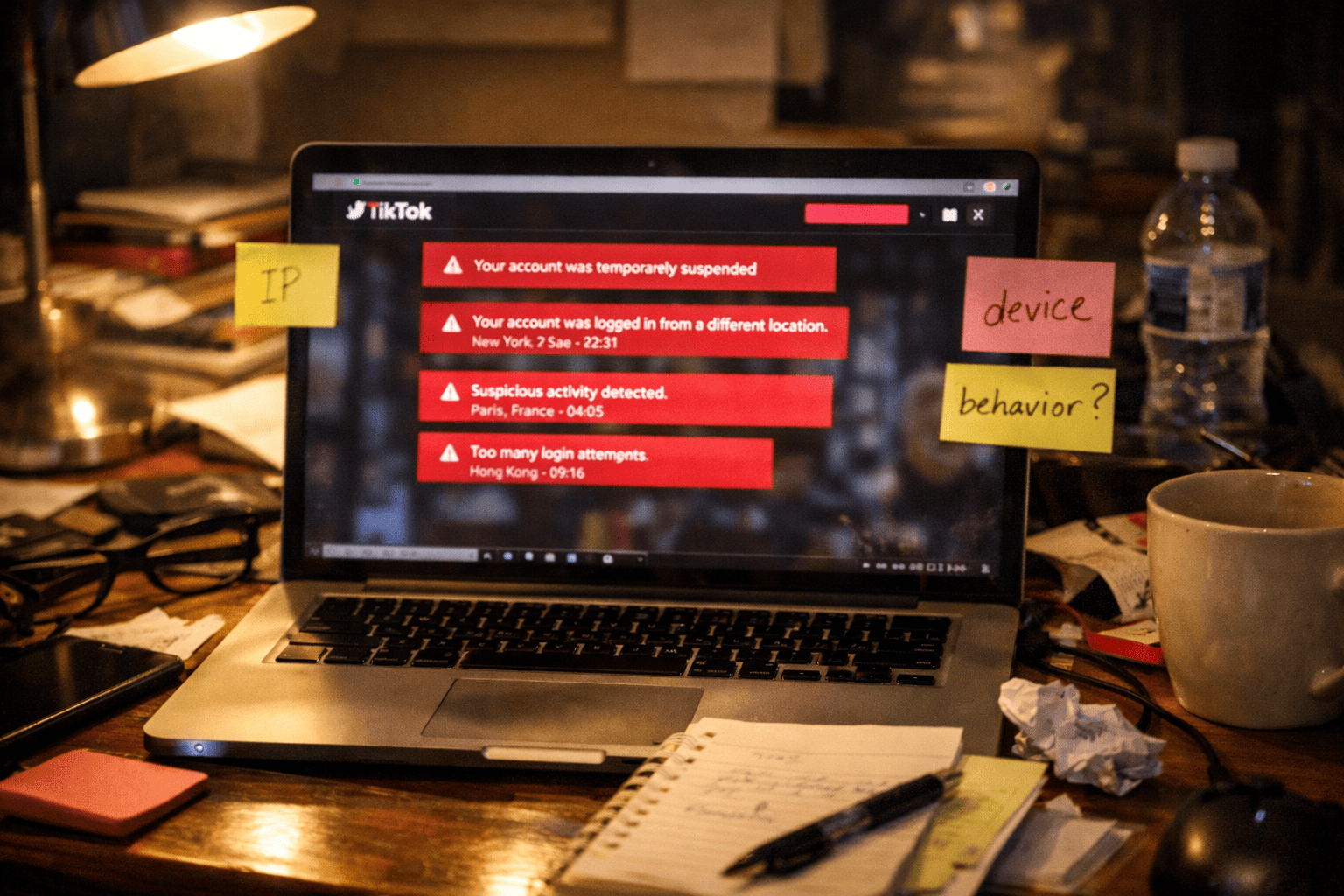
TikTok removed 214 million accounts in Q3 2024 alone for Community Guidelines violations, according to the platform's official Transparency Report. Of those, automated detection caught over 80% before human review—a 15% increase from the previous year. If you're running multiple accounts without understanding how this detection actually works, you're operating blind against a system processing billions of signals daily.
This isn't a guide promising easy success. Managing multiple TikTok accounts involves real costs ($125-400+/month for proper infrastructure), genuine failure rates (even well-configured setups see 5-15% account loss), and legal gray areas worth understanding before you start.
TikTok's Three-Layer Detection Architecture
TikTok's risk control operates across network, device, and behavioral layers simultaneously. Understanding each layer's specific signals—and their limitations—matters more than any single "solution."
Layer 1: Network Analysis
TikTok tracks IP addresses, but the analysis goes deeper than simple matching. The platform examines:
ASN classification: Whether your IP comes from a residential ISP (Comcast, Verizon, BT) versus a datacenter (AWS, Google Cloud, Hetzner). According to Chameleon Mode's 2026 detection research, datacenter IPs face immediate heightened scrutiny on social platforms.
IP reputation databases: Cross-referencing against services like MaxMind, IPQualityScore, and internal blocklists of IPs previously associated with spam or coordinated behavior.
Geographic consistency: An account created in Miami suddenly accessing from Singapore triggers review. TikTok's Transparency Center documentation confirms geographic anomalies are key enforcement signals.
Connection patterns: Multiple accounts accessing from the same IP within short timeframes, or IPs cycling rapidly during single sessions.
What TikTok's official documentation doesn't reveal is the specific threshold—how many accounts per IP trigger flags, or exact geographic distance limits. This opacity is intentional and means even "best practices" involve educated guessing.
Layer 2: Device Fingerprinting
This is where most multi-account operations fail. TikTok collects 100+ device parameters to create unique identifiers, per analysis from security researchers at ToDetect. Key fingerprint components include:
Canvas rendering: Your GPU produces slightly different pixel outputs when drawing the same image. Academic research has demonstrated that Canvas fingerprinting, when combined with a few additional signals, achieves very high identification rates across browsers.
WebGL parameters: GPU vendor strings, renderer information, supported extensions. Mismatches between claimed GPU capabilities and actual WebGL parameter limits create detectable inconsistencies.
TLS/JA3 fingerprints: Your connection's encryption negotiation reveals what software initiated it. Different browsers—and different versions of the same browser—produce distinct handshake patterns. Detection systems compare your claimed browser identity against your actual connection behavior.
Audio context: Subtle variations in how your system processes audio through the Web Audio API.
The critical insight from fingerprinting research: maintaining consistency across signals matters more than achieving any particular fingerprint profile. Detection models learn from legitimate user populations who have stable device configurations. Attempting to randomize or frequently change fingerprints creates statistical anomalies that stand out against normal user baselines.
Layer 3: Behavioral Analysis
Even with perfect network and device isolation, behavioral patterns can link accounts:
Engagement cadence: Identical posting schedules, similar comment timing, synchronized follow/unfollow patterns across accounts.
Content interaction: Watching the same videos, lingering on similar content categories, scrolling at mechanized speeds.
Session characteristics: Login/logout timing, session duration patterns, navigation paths through the app.
TikTok's September 2025 algorithm update specifically targeted "engagement farming" with video completion rate becoming the primary metric for content survival, per Shortgen.io analysis. Accounts that behave like bots—even with human operators—face reduced reach before outright bans.
What Actually Works (And Its Limitations)
Residential Proxies: The Foundation
Residential IPs—those assigned by ISPs to actual households—pass ASN checks that datacenter IPs fail. Per Proxyway's 2026 market research testing over 2 million requests across major providers:
Residential proxies achieve 85-95% success rates on protected platforms
Datacenter proxies often succeed less than 50% on the same targets
84% of websites fail to detect residential proxy traffic, according to Decodo's 2025 analysis
However, residential proxies alone don't solve multi-account management. They address network-layer detection while leaving fingerprint and behavioral layers exposed.
Cost reality: Residential proxy pricing has dropped significantly—2025 rates are approximately 3x cheaper than 2023. Current market pricing:
| Volume | Price Range | Provider Examples |
|---|---|---|
| Pay-as-you-go | $4-8.50/GB | Decodo, Oxylabs, IPRoyal |
| 10-50GB/month | $3.50-5.50/GB | Decodo, GeoNode |
| 100GB+ | $1.50-3.30/GB | Bright Data, Massive |
For TikTok account farming, expect to use 500MB-2GB per account monthly with active engagement, translating to $50-200/month for a 10-account operation using quality residential IPs.
Anti-Detect Browsers: The Fingerprint Layer
Tools like Multilogin, GoLogin, and Octo Browser create isolated browser profiles with distinct fingerprints. Key capabilities:
Spoofing Canvas/WebGL rendering signatures
Managing timezone, language, and screen parameters
Maintaining separate cookies, cache, and local storage per profile
Some handle TLS fingerprint matching (critical but often overlooked)
Pricing for anti-detect browsers:
Multilogin: From €5.85/month (after €1.99 trial)
GoLogin: From $49/month
Octo Browser: From $29/month
The combination requirement: Neither proxies nor anti-detect browsers work reliably alone. Per Multilogin's own testing, "hiding your IP isn't enough—sites track browser fingerprints, cookies, and sessions too." You need both layers aligned, plus behavioral discipline.
The Honest Failure Modes
Even well-configured operations experience losses. Understanding why helps set realistic expectations:
1. IP Pool Contamination
Residential proxy pools are shared. If another user abuses the same IP—spam, fraud, automated scraping—that IP develops negative reputation affecting your accounts. Quality providers actively manage pools, but you can't control other users' behavior.
Mitigation: Choose providers with large, actively maintained pools. Check IP reputation before assigning to valuable accounts using services like IPQualityScore.
2. Fingerprint Inconsistencies
The hardest detection to avoid: mismatches between what your fingerprint claims and what detection systems expect. Examples:
Windows User-Agent + Safari browser characteristics
Desktop screen resolution + mobile touch event support
High-end GPU claim + WebGL parameters showing software rendering
According to Chameleon Mode's research, "If your TLS fingerprint says 'Chrome 120', your HTTP/2 settings must match Chrome 120, your User-Agent must say Chrome 120, and your canvas rendering must produce Chrome 120 artifacts. One mismatch = detection."
3. Behavioral Correlation
Operating 10 accounts that all post at 9 AM, all follow accounts in the same niche, and all engage with similar content creates statistical patterns that survive even perfect technical isolation.
4. Platform Algorithm Updates
TikTok updates detection continuously. The September 2025 algorithm change specifically addressed coordinated behavior detection. Methods working in January may fail by June.
Practical Implementation Framework
Phase 1: Account Warmup (7-14 days)
New accounts receive elevated scrutiny. During warmup:
One account, one IP, one fingerprint profile—no sharing
Engage naturally: watch content, follow accounts in your target niche, leave genuine comments
Avoid posting until the For You page recommendations align with your target content (typically 200+ views consistently on early posts indicates adequate warmup)
Maintain the same IP throughout—switching during warmup is worse than a single consistent connection
Per GeeLark's testing, warmup typically takes 7-14 days depending on activity levels. Rushing this phase is the single most common failure cause.
Phase 2: Active Operation
Maintain IP and fingerprint pairing established during warmup
Scale posting gradually—sudden volume increases trigger review
Vary engagement timing across accounts (don't have all accounts post at 9 AM)
Monitor for early warning signs: verification challenges, reach drops, login difficulties
Phase 3: Ongoing Maintenance
Audit IP reputation quarterly
Update browser profiles when platform detection evolves
Replace flagged IPs promptly—continuing to use a flagged IP damages associated accounts
Document configurations for troubleshooting and continuity
When This Approach Doesn't Make Sense
Honest assessment of limitations:
Scale limitations: Managing 5-10 accounts with proper isolation is feasible for individuals. Managing 50+ requires dedicated infrastructure, significant budget ($500+/month), and operational expertise. At 100+ accounts, you're running a business that probably needs different solutions (agency accounts, official partnerships).
Content that violates policies: No amount of technical sophistication protects accounts posting content that violates TikTok's Community Guidelines. The 147 million videos removed in Q3 2024 weren't removed for technical detection reasons—they violated content policies.
ROI questions: If you're spending $300/month on infrastructure for accounts generating $200/month in value, the math doesn't work. Calculate expected revenue against infrastructure costs before building.
Legal considerations: Multi-account operation exists in a gray area. TikTok's Terms of Service discourage it; they don't explicitly prohibit legitimate business use cases. However, if account behavior violates other policies (spam, fraud, deception), technical evasion compounds legal exposure rather than reducing it.
What Proxy001 Offers for This Use Case
For operators who've evaluated the costs, limitations, and legal considerations and decided multi-account management fits their business model:
Proxy001's residential proxy network provides the network-layer foundation this approach requires. Global IP coverage across 150+ countries enables geographic matching for region-specific content strategies. Flexible session options support both the sticky sessions needed for consistent account access and rotation capabilities for research activities. HTTP/S and SOCKS5 protocol support ensures compatibility with major anti-detect browser platforms.
The infrastructure decisions matter—pool size, IP quality management, geographic coverage, session control. But infrastructure is only one layer of a multi-layer challenge. Success requires combining quality proxies with fingerprint management, behavioral discipline, and realistic expectations about ongoing account loss rates.