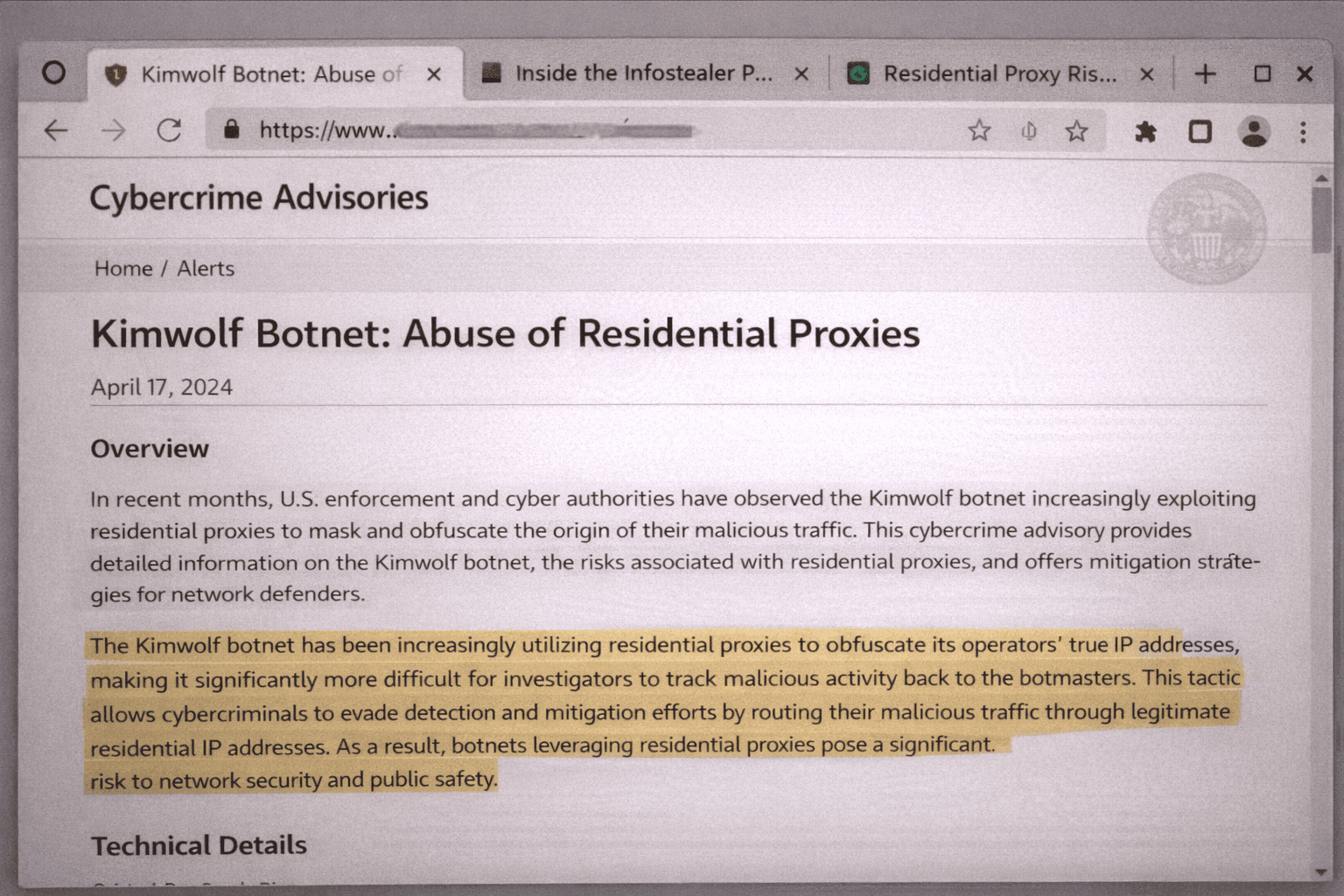
The residential proxy market took a dark turn in late 2025 when the Kimwolf botnet emerged, compromising over 2 million Android devices and transforming innocent household internet connections into criminal infrastructure. If you're evaluating proxy providers right now, this isn't just about speed or IP pool size anymore—it's about whether your provider might inadvertently connect you to a criminal network.
I've spent the past three months investigating how major proxy services source their IPs following the FBI's June 2025 advisory on BADBOX 2.0 and the subsequent Kimwolf revelations. What I found reshaped how we evaluate providers at proxy001.com, and it should change how you approach this decision too.
The Kimwolf Reality: What Actually Happened
In October 2025, security researcher Benjamin Brundage at Synthient began tracking an Android botnet that would eventually infect millions of devices. The infection vector wasn't sophisticated malware—it was residential proxy software already installed on cheap Android TV boxes and digital photo frames sold through major e-commerce platforms.
According to Synthient's January 2026 research, the botnet exploited a fundamental weakness: approximately 67% of devices in residential proxy pools had unauthenticated Android Debug Bridge (ADB) services. Attackers manipulated DNS records to bypass RFC 1918 private IP range restrictions, tunneling into home networks through legitimate proxy endpoints. Once inside, they could scan and infect vulnerable devices within minutes.
The geographic distribution tells its own story—heavy concentrations in Vietnam, Brazil, India, and Saudi Arabia, with approximately 12 million unique IP addresses observed weekly. Infoblox's analysis found that nearly 25% of their enterprise customers had made queries to Kimwolf-related domains since October 2025, indicating the botnet had penetrated corporate and government networks through employee devices running proxy software.
The Criminal Liability Problem You Haven't Considered
Here's the aspect most "best proxy" articles won't discuss: when you route traffic through a botnet-compromised residential IP, you may be participating in criminal infrastructure without knowing it.
The FBI's 911 S5 takedown in May 2024 established clear precedent. That botnet operated since 2014, compromising 19 million IP addresses across 190 countries. The DOJ estimated $5.9 billion in fraud losses from 560,000 fraudulent unemployment claims alone, plus over 47,000 fraudulent Economic Injury Disaster Loan applications—all routed through what appeared to be ordinary residential connections.
The administrator, YunHe Wang, now faces 65 years in prison. But the legal exposure extended beyond operators. Businesses that used these proxy services for data collection, ad verification, or market research suddenly found their activities intermingled with criminal infrastructure. Treasury sanctions followed, freezing assets and complicating legitimate business operations.
The pattern repeated with Cloud Router (911 S5's successor), BADBOX, and now Kimwolf. Each time, the question became harder to answer: how do you prove your traffic wasn't part of the problem?
Due Diligence Framework: Questions Most Buyers Forget to Ask
After analyzing incident reports and speaking with compliance teams at affected organizations, I've developed a verification framework that goes beyond marketing claims.
IP Sourcing Transparency
Legitimate providers can explain exactly how they acquire residential IPs. The ethical standard—established partly through the EWDCI (Ethical Web Data Collection Initiative)—requires explicit user consent and fair compensation. Ask providers directly: "How do you acquire your residential IPs?" Vague answers about "partnerships" or "proprietary networks" are red flags.
Reputable providers like those with EWDCI Certified designation (currently including Oxylabs, Rayobyte, Smartproxy, NetNut, and Zyte) have undergone third-party verification of their sourcing practices. This doesn't guarantee immunity from botnet contamination, but it establishes a baseline of accountability.
Device Verification Practices
After Kimwolf, this became critical. Providers should actively scan their networks for signs of botnet activity and remove suspicious endpoints. Ask whether they monitor for: exposed ADB services, anomalous traffic patterns, pre-infected device signatures, and connections to known C2 infrastructure.
The honest answer is that this monitoring is imperfect. Synthient's research showed Kimwolf infections could establish themselves within minutes of a device joining a proxy pool. But providers who admit these limitations while explaining their mitigation strategies are more trustworthy than those claiming perfect security.
Compliance Documentation
Request evidence of GDPR and CCPA compliance, KYC (Know Your Customer) procedures for clients, and acceptable use policies with actual enforcement mechanisms. Providers serving enterprise clients typically maintain SOC 2 certification or equivalent third-party security audits.
Technical Indicators of Potentially Compromised Networks
When testing residential proxy services, watch for these warning signs that emerged from Kimwolf analysis.
Unusual Geographic Concentrations
Kimwolf's heavy presence in Vietnam, Brazil, India, and Saudi Arabia wasn't random—these markets have high concentrations of cheap Android TV boxes with poor security. If a provider's pool shows disproportionate availability from these regions without transparent explanation, investigate further.
Pricing Anomalies
Kimwolf operators sold residential proxy access for as low as $0.20 per GB—far below sustainable rates for ethically-sourced IPs. Legitimate residential proxies require compensating device owners, maintaining infrastructure, and implementing security measures. Extremely low pricing often indicates compromised sourcing.
Response Time Inconsistencies
Botnet-based proxies often show unusual latency patterns because traffic routes through consumer devices with variable connection quality. While residential proxies naturally have more variable performance than datacenter alternatives, extreme inconsistency may indicate infected device pools.
The ISP Proxy Alternative Worth Considering
The Kimwolf situation accelerated interest in ISP proxies—IPs sourced directly from internet service providers rather than consumer devices. While ISP proxies have existed for years, they've become increasingly attractive for businesses prioritizing security over pure residential authenticity.
The tradeoff is real. ISP proxies offer greater stability and lower botnet risk because they don't depend on consumer device networks. However, sophisticated anti-bot systems can distinguish ISP proxy traffic from genuine residential connections. For some use cases—particularly those requiring the absolute highest trust scores—residential proxies remain necessary.
The practical approach for most organizations is a hybrid strategy: ISP proxies for routine operations, verified residential proxies for specific requirements, and continuous monitoring regardless of proxy type.
Building a Verification Process That Actually Works
Based on our experience evaluating providers post-Kimwolf, here's a practical verification sequence.
Start with public information. Check whether the provider has EWDCI certification, SOC 2 reports, or other third-party validations. Review their published privacy policy and acceptable use terms for specificity—vague policies suggest unclear practices.
Request direct answers about IP sourcing. A provider comfortable explaining their acquisition methods, compensation structures for device owners, and consent mechanisms has nothing to hide. Reluctance or deflection suggests potential problems.
Test before committing significant resources. Most reputable providers offer trial access. During trials, monitor for the technical indicators described above. Use services like Spur.us to check whether test IPs appear on known botnet or abuse lists.
Establish ongoing monitoring. The proxy landscape shifts constantly. Providers that appear clean today may face contamination tomorrow as botnets evolve. Maintain relationships with security-focused customers and industry researchers who track these developments.
What We Got Wrong Initially
I'll be honest about our own learning curve. When Kimwolf first emerged, we assumed that simply avoiding the cheapest providers would protect against botnet exposure. That assumption proved naive.
Synthient's research showed that IPIDEA—described as the world's leading IP proxy provider with 6.1 million daily updated addresses—had significant Kimwolf contamination despite being a major market player. The issue wasn't provider size or pricing tier but rather fundamental security architecture that allowed DNS manipulation to bypass network restrictions.
This reinforced an uncomfortable truth: no provider can guarantee complete protection from increasingly sophisticated botnet operators. The best you can achieve is working with providers who acknowledge this reality, invest seriously in detection and mitigation, and maintain transparency when incidents occur.
Secure Your Operations with Proxy001's Verified Residential Network
At proxy001.com, we've built our residential proxy infrastructure with post-Kimwolf security requirements as foundational design principles—not afterthoughts. Our network sources IPs exclusively through transparent consent-based partnerships where device owners receive fair compensation and maintain complete control over their participation.
Every IP in our pool undergoes continuous monitoring for botnet signatures, exposed services, and anomalous behavior patterns. We maintain documented KYC procedures for all clients and provide detailed compliance documentation for enterprise security reviews. Our technical team actively tracks emerging threats through relationships with security researchers and promptly removes any endpoints showing compromise indicators.
Try our residential proxy network with confidence—start with our trial access to verify performance and security characteristics in your specific use case. Visit proxy001.com to learn how we protect your operations from the criminal risks plaguing less vigilant providers.